

Why Closing Your Books in August (Not September) Saves You from Filing Wrong
Every year, thousands of UAE businesses circle September on their calendars because it is commonly associated with Corporate Tax filing deadlines for businesses with a 31 December financial year-end. That habit creates a dangerous misconception: many business owners believe September is the month to start preparing their books.
It isn’t.
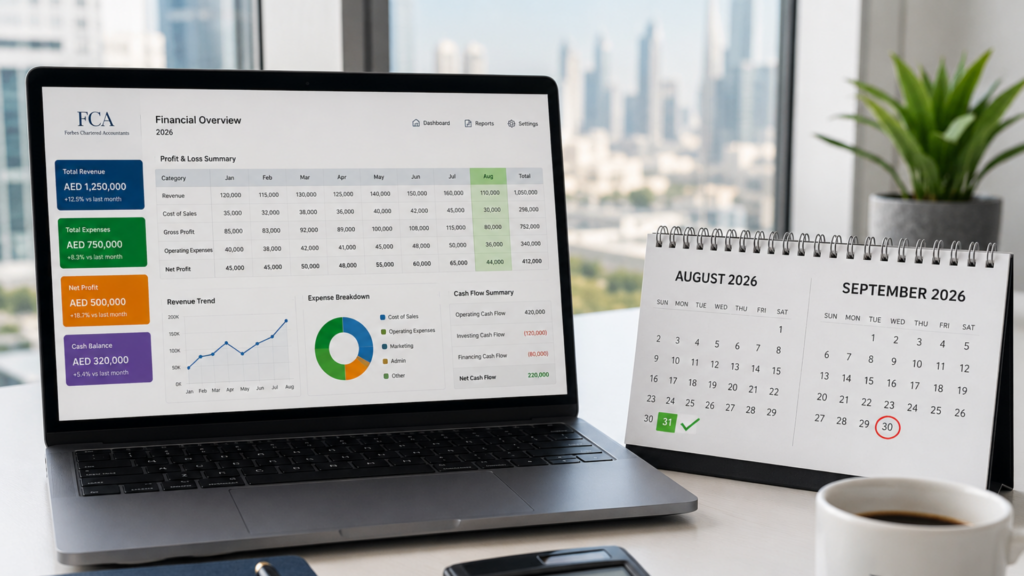
The smartest businesses treat August as the final month for completing their accounting, not September. By the time September arrives, the focus should be on reviewing, validating, and filing—not scrambling to fix months of unaligned bookkeeping.
The UAE’s Federal Tax Authority (FTA) requires Corporate Tax Returns to be submitted within nine months after the end of the relevant tax period, while businesses must retain support records for at least seven years. Accurate financial records are the foundation of every tax return, making timely bookkeeping essential for regulatory compliance.
Understanding the September Filing Myth
Many business owners assume that because the filing deadline falls in September, bookkeeping can wait until then. Unfortunately, accounting doesn’t work like writing an assignment the night before it’s due.
Your Corporate Tax Return is simply the final output of months of financial activity. Every sales invoice, supplier payment, payroll expense, depreciation entry, VAT adjustment, and bank reconciliation contributes to that final figure.
Analogy: Imagine building a skyscraper. You wouldn’t pour the foundation on the same day you’re installing the roof. Filing tax returns works the same way—the structural preparation happens long before submission.
Waiting until September often means trying to complete bookkeeping, perform reconciliations, prepare financial statements, calculate tax adjustments, and submit the return—all within a few stressful weeks. That drastically increases the likelihood of costly mistakes.
Why August Is the Ideal Time to Close Your Books
Closing your books in August gives your finance team—or your external accounting firm—the breathing room needed to verify every figure before submission.
- Identify Missing Transactions: Businesses often discover unpaid supplier invoices, duplicate expenses, unrecorded revenue, or miss bank entries during the closing process. Finding these issues in August allows sufficient time to investigate and correct them without rushing.
- Reliable Financial Statements: Management can review profitability, cash flow, and balance sheet positions before those numbers form the legal basis of tax reporting.
- Proactive Tax Advice: Professional tax advisers consistently recommend completing bookkeeping well before filing because Corporate Tax preparation involves much more than simply filling in an online form. It requires accurate accounting records, reconciled balances, and complete supporting documentation.
The Hidden Risks of Waiting Until September
Businesses that postpone their accounting until September face critical risks that could be avoided entirely:
1. Rushed Financial Reconciliations
Bank accounts may contain unreconciled transactions stretching back several months. Credit card statements may not match accounting records, and cash transactions could remain unrecorded. When accountants are forced to reconcile everything at the last minute, the chances of overlooking discrepancies increase significantly.
2. Incorrect Expense Classification
Corporate Tax laws strictly distinguish between deductible and non-deductible expenses. If expenses have been incorrectly classified throughout the year, identifying and correcting them under deadline pressure becomes exponentially harder. Common pitfalls include:
- Personal expenses recorded as business costs
- Entertainment expenses treated incorrectly
- Capital purchases expensed instead of capitalized
3. Discrepancies Between VAT and Corporate Tax
Although VAT and Corporate Tax are separate tax systems, inconsistencies between VAT records and financial statements frequently attract attention during FTA compliance reviews. Revenue reported for VAT purposes should generally align with accounting records unless there is a legitimate timing or technical difference. Reconciling these figures takes time and should never be left until the filing month.
4. Missing Supporting Documentation
Invoices disappear, contracts become difficult to locate, bank confirmations take days to obtain, and supplier statements remain outstanding. Finding these documents in August is manageable; finding them two days before filing causes unnecessary risk.
Key Accounting Areas to Review Before September
A proper August close isn’t just about locking your accounting software. It involves thoroughly auditing every major financial sector:
| Financial Area | Why It Matters for Corporate Tax |
|---|---|
|
Bank Reconciliations |
Ensure accounting records match actual bank statements. |
|
Accounts Receivable |
Identifies overdue invoices, bad debts, and bad debt provision adjustments. |
|
Accounts Payable |
Confirms supplier balances and accrued expenses are accurate. |
|
Inventory |
Prevents valuation errors that directly affect net profit calculations. |
|
Fixed Assets |
Reviews depreciation rates, asset disposals, and new capital additions. |
|
Payroll |
Confirms wage protection system (WPS) and salary expenses are correctly posted. |
|
VAT Reconciliation |
Matches filed VAT return with general ledger revenue and expense accounts. |
|
Related-Party Transactions |
Ensures complete transfer pricing documentation where applicable. |
Completing these reviews before September transforms tax filing into a validation exercise instead of a rescue mission.
August Book Closing Checklist
Before September begins, ensure your finance team has completed the following steps:
- Complete all routine bookkeeping entries.
- Reconcile every business bank account and credit card.
- Verify customer (AR) and supplier (AP) balances.
- Review stock/inventory records.
- Update fixed asset registers and record depreciation.
- Match VAT returns against accounting general ledgers.
- Document and review all related-party transactions.
- Prepare draft financial statements (P&L and Balance Sheet).
- Collect supporting invoices and contracts for high-value transactions.
By shifting your accounting deadline to August, you transform Corporate Tax preparation from a high-stress emergency into a controlled, routine review. Finishing your bookkeeping early guarantees accurate calculations, secures vital documentation, and prevents costly errors—giving you complete confidence and peace of mind when filing season arrives.